Showing posts with label Review. Show all posts

Saturday, 19 October 2013

Back to the future with Chainsaw Warrior

Chainsaw warrior was originally released as a board game in 1987 by Games Workshop. The rules were pretty simple, players had 60 minutes to fight their way through a New York building in order to defeat uber-villain Darkness, but this was a very difficult task to achieve and if the Meat Machine didn't get you then the endless traps would. I played this game a lot as a 14 year old and now, 26 years later, you can die repeatedly whilst travelling to work or sitting on the toilet as Auroch Digital have brought all of the frustration of the original to your phone or tablet. Isn't technology wonderful?

The player starts by rolling some dice in order to create their very own version of our plucky, taciturn hero. Attributes are pretty basic and cover things like overall health, the amount of radiation or venom you can withstand and your skill with guns or stabby things. They are set by rolling dice (on the computer, not actual dice, this is 2013) and the number used depends on the difficulty level that you have chosen. I was actually thinking about picking easy or medium as I remember this game being particularly tricky to complete but it says that hard is the same as the original game, so that really only left me with one option. You can play on easy if you like, nobody's judging.

It is at this point that you also determine how much equipment you can take with you and get to choose the categories that it comes from. This bit is a little like Countdown "I'll have one hand to hand weapon, a heavy weapon and two from the clothing pile please Rachel." In fact the whole equipment thing is a bit weird. You are humanity's last hope, the fate of the world rests upon your broad, broad shoulders and if you're unlucky you can be sent to almost certain death with a small knife, some wire cutters and a pair of glasses. You'd think that the shadowy general who guilt trips you into this whole mess would at least give you the bloody chainsaw that you're named after but no, apparently that’s not part of the deal.

Anyway you are soon equipped with your pitiful collection and sent off into a huge building containing the living embodiment of pure evil. I imagine everybody else gives you a hearty slap on the back and wishes you well, but nobody comes with you, which might have helped to be honest. The way the game works is that you have 108 cards split into 2 decks. Darkness, the baddie, is always in the 2nd deck and so you have to get through to that in order to fight him. Cards contain various things; zombies and other monsters to fight, traps to avoid and the very rare supply drop (which makes you to fall to your knees and thank the Lord above for His great mercy). Combat is commonplace and uses dice rolls to determine who wins and enemies range from the ever-present zombies to the fearsome and pretty gruesome Meat Machine. Your equipment helps you to overcome obstacles and kill monsters but you will never be able to get past everything and you are sometimes even forced to backtrack out of the building in order to find another way forward, which is particularly galling.

And I'm not casting aspersions here, but you should probably prepare yourself for frequent failure as there are lots of ways to die in Chainsaw Warrior. For a start there's a time limit because, obviously, Ultimate Evil runs on a schedule. You have 60 minutes to save the world and each turn of a card uses up 30 seconds. This means that it will take at least 27 minutes to get through the first deck even if everything goes great (it won't) and once the 60 minutes are up then the world is destroyed.  Of course there are also more traditional ways to die - too much chomping from zombies, too much venom from zombies and too much radiation from everything else - and then, of course,there are the traps. Some just delay you, some hurt you and some hurt you, delay you and then destroy your precious equipment. Being a Chainsaw Warrior is no life.

It's got to be said that Auroch digital have done a great job of transferring this old board game to modern equipment. The cards are exactly the same as they were back in the day, with 80s gems like the Laser Lance all still there and effects have also been added for when you are infected with venom or use items like the flash bombs. The interface can be a little bit clunky sometimes, especially when you are asked to choose the same weapon over and over again for every round of combat but I'm not sure how else this could have been done. The game itself works in exactly the same way as it always did and, as far as I can see, this hasn't been changed at all. I'm not sure whether that is a testament to the original or to Auroch digital but whatever, more power to them.
This game is harsh and hugely random, with the initial rolls essentially determining whether you have any chance of success. You might be able to get by if you have one decent attribute, but if you roll low for everything then you have no chance at all. The temptation to bin a rubbish character and try again is always there but high scores are still no guarantee of victory and it only takes a few traps to ruin even the best character's play through. However, I should probably say now that I did manage to destroy Darkness with a suicide vest on my 2nd go (which technically counts as a draw) but that's obviously down to my l33t gamer skillz (and a large dose of luck). So be prepared for repeated frustration, victory does not come easy.  In fact it could be argued that Chainsaw Warrior is an early example of that now trendy genre, the roguelike. It has perma-death, it's very explicitly turn-based and the cards create a new random building every game. Just goes to show that the more things change the more they stay the same.

Chainsaw Warrior is a great recreation of a cult classic. It works really well on mobile devices, is perfectly suited to being played in short bursts and offers a range of difficulty levels for the easily discouraged. What's more it only costs £2.99 and there are no in-app purchases of any kind, which is good for my blood pressure. You should remember that I did play this a lot in my room as a 14 year old (probably whilst listening to Janet Jackson) so my views are always going to be tinged with a certain amount of nostalgia, but I would heartily recommend this to anybody who fancies something a bit different. It may be very difficult and very random but it is also a highly polished version of a great game and, most of all, it's fun.

Thursday, 15 August 2013

Call of Cthulhu: The Wasted Land


I got very excited when I heard about Call of Cthulhu: The Wasted Land, which is a game set firmly in the world of  HP Lovecraft - an American writer from the 1920s and 30s who wrote short stories about Old Gods, unspeakable horrors and lands beyond dreams.  He was obsessed with madness, with things living in the shadows of our perception which hate humanity with an intensity that is inconceivable to our mortal minds; powerful, ancient, horrific things determined to destroy our world and everything in it.  You can see why I was excited.

The game itself is a turn-based strategy game; much like Xcom (or, indeed, X-Com), Fire Emblem or Advance Wars.  Each side take turns moving all of their "pieces", and action points determine how much each character can do during those turns.  Moving, attacking or using items all costs a specified number of points and once your characters have used all of these up then it's time for the other side to have a go.  There are no time limits on how long you can take to plan out your moves, you can think for as long as you like, and so this kind of game is well suited to playing on the go.

You control a team of up to 6 characters, some of whom have to survive each mission whilst others are a bit more expendable, and they all have varied skills and attributes.  There are different weapon skills which determine how effective you are with the different weapon types (handguns, shotguns, rifles, machine guns and stabby things), there are skills which govern healing or being able to put a gas mask on properly and there's even a "psychotherapy" skill - because first world war trenches are apparently an ideal place for a bit of person-centred counselling.


In addition to this characters can also use different equipment such as weapons, armour or the ubiquitous first aid boxes.  All of these can also be upgraded later in the game, although there is only one stronger variant for each type of weapon which is a little bit disappointing.  On the other hand there are four different types of armour, various spells and the Sapper can even call in artillery – so there’s a fair amount of options available to you. 

The Wasted Land is split into 11 different tactical missions, with some basic exposition in between, and pits the player against an evil German cult determined to bring the Old Gods back to Earth so that they can destroy humanity and enable a new world to rise from the ashes (Mwuahaha!).  Not the greatest or wisest plan I've ever heard but you know, cultists gonna cult.  Your team, on the other hand, are a nice mix of down to earth Tommies "Crikey! That chap's already dead!" and more mysterious blighters like the extravagantly turbaned Professor Brightmeer.  The action is set across the trenches, no man's land and destroyed churches of First World War France but with Lovecraftian elements added in.  So your characters can cast spells, encounter nasty slobbering monsters or be driven stark raving mad by the horrors they experience.  Lovecraft was an amazingly creative writer and the story and setting is one of the best things about this game.  It uses this very well and it fits perfectly with the gritty realities of trench warfare.  If I wanted to be pretentious I could talk about how the lines of reality are already blurred when man can be so brutal to his fellow man - but it certainly allows for the supernatural to gradually take over the story in a way that might seem jarring elsewhere.  The difficulty level is reasonable, I didn't have many problems in completing it apart from one particular issue which I'll talk about later and money isn't plentiful to the point of being meaningless but still allows you to buy upgrades for your stuff.

It's a strong fashion statement

However it's not all ballgowns, tiaras and the reawakening of primordial forces who should have been left to their eternal slumber.  The game did, admittedly, stand up to some of my basic "is this a rubbish game?" tests (you can't call in artillery underground) but it also suffers from a number of actually quite important problems. To start with, let's look at the whole insanity thing.  In the original pen and paper RPG "Call of Cthulhu" your character had a Sanity attribute and every time they met up with something slimy they lost points from this until, eventually, they went irredeemably insane.  However, in Wasted Land madness is sometimes a good thing and while this may be striking a blow for mental health advocacy it also comes across as pretty contrived.  Here lots of things affect sanity - casting spells, attacking monsters, monsters attacking you etc. and once this gets to 0 you are either paralysed or go into a frenzy – during which you actually get lots more action points for a few turns before you collapse.  This is explained by Prof. Brightmeer teaching you some yoga or something which at least fits in with the milieu but still means that madness is just a temporary state of mind.  And, not only this, but you can be cured at any time by somebody psychoanalysing you - even in the middle of a gas-filled trench surrounded by the shambling dead.  Sanity is treated as just another health bar and it says a lot that in a game full of evil cultists, opponents from beyond the grave and indescribable horror this was the bit which stood out as unrealistic.

The tactics side of things also feels a bit light.  To start with, there are LOADS of enemies.  On some missions I was killing upwards of 60 opponents and this means that it all becomes a bit of a grind.  Most of them have to close to clawing range before doing any damage and so it can feel like you're shooting ducks at the fairground on occasion.  They shuffle towards you, you shoot the closest one, some more appear and repeat to fade.  That's not to say that it lacks challenge, you often have to think about how to manage the situation, but the endless array of attackers that pop up only to be quickly knocked back down can be wearing.  The enemy AI is also not great, and they will often walk straight through a gas cloud - killing themselves before you even get the chance to plunge a sharpened entrenching tool into their rotten chest. 

However the biggest, and almost game-breaking, problem I had with the Wasted Land was how enemies spawn.  There seem to be a number of trigger points on the map and once you reach those points then opponents appear.  The problem is that they appear at the start of their own turn, sometimes right next to you, and will often kill your characters without you being able to do anything about it.  This directly lead to me failing a couple of missions and was an immensely frustrating part of the game.  Eventually you come to expect it, and leave all your characters on opportunity fire to try and combat it, but it's still just really shoddy game design and shouldn't happen. 

So it's strange that, even though all of these problems undoubtedly exist and even though they were definitely really annoying I still quite enjoyed playing this game.   Now this may be because I was on public transport for a lot of it and the game's cast of shambling horrors and reanimated corpses were more enticing than what was actually around me.  It may also be that its turn-based, strategy-lite approach fitted perfectly with what I wanted from a game at that time but I admit that I had no strings attached, uncomplicated fun with it and that is something you should never, ever turn your nose up at.  I mean, the game costs £2.99 or something, the Professor's magnificent turban is worth that on its own.


The Wasted Land is available on iOS, Android and PC.  I played it on a Nexus 7.

Wednesday, 26 September 2012

Torchlight II - The Good, The Bad and the Ugly

So... Torchlight II.  I'm in a bit of a pickle, to be honest, because I have already done a preview and it seems like I'd just be duplicating stuff if I sat here and wrote a proper review.  However, I am sure that is what you are expecting, so here’s a quick one if you’re desperate.  “Wow, look at that!  I can do what?  OMG!  Look at that fire!  Ha, isn’t he cute?  Wait a minute, I can get him to summon zombies?  Jesus.  Look at them!  Fantastic!”

So there you go. 

Instead of a review I’m going to list some of the good and bad things about the game, my own personal reaction rather than a full on review.  There are plenty of those out there already, it's hardly a secret.

The Good.

Explosions.  Lots and lots of lovely explosions.  Some of the Embermage skills, in particular, create very pretty and lethal patterns but all of the classes have access to some spectacular effects.  Monsters are blown backwards by your awesome powers and, if you hit them with a critical, they EXPLODE and their blood splatters all over the scenery.

Choice.  Each of the 4 character classes has 3 different skill trees.  So, for example, the Embermage can use fire, ice or lightning.  The Engineer can focus on 2-handed weapons, sword & board or summoning (or any mixture of the 3).  This means that you have to think and plan and all those other good gaming things, and also that you can replay the game with a completely different character (even whilst using what is ostensibly the same class.)   There is real flexibility in how you play the game, and that is good.

Clicking.  There is lots and lots of clicking.  Make sure your mouse is in good working order.  Click where to go, click on things till they die and then click on the resulting loot that explodes from their bodies.  Click, click, click, click, CLICK.  It’s gaming stripped to its essence.  It’s almost therapeutic in its simplicity.  Clear your mind, focus on the void and click until you achieve Nirvana.

Regular rewards.  Every few minutes SOMETHING comes along.  Whether it’s a new level, a new weapon, a piece of armour, some gold or whatever – there’s always something.  Pretty much constant progression, just by clicking on things.  Your character improves, your gear improves, the enemies improve and it only stops when you beat everything.  BOOM.

Pets.  The pets are great.  Everything about them is quality.  They’re great in a fight, you can give them SPELLS TO CAST (so they can summon things to help you, or shoot fireballs from their little paws) and you can even transform them into other creatures for a bit when you get bored.  Not only this, but they take all the useless tat you pick up from your adventures and sell it for you back in town – which allows you to stay out cracking (or burning, or poisoning or freezing) skulls in the wild.  AND, not only THAT, but they can also pick up supplies for you in town while they’re there.  They’re amazing.  They have more functions than a bloody Swiss Army Knife and I love them to pieces.

Guns.  Torchlight hasn't gone for your standard fantasy stuff.  I mean, sure, there are swords and spells and zombies and things, but there are also guns.  Wonderful, shiny guns which are immensely satisfying to use and which blow seven shades of shit out of your enemies.  I would say that more games need guns but you know... that wouldn't be true.  However, that does lead me on to my next point..

Fun.  The game is just really fun to play.  It gives plenty of "WHOA, DID YOU SEE WHAT JUST HAPPENED?!?" moments and it gives you plenty of really cool things to play with.  I found myself picking skills not because I thought they were the best thing for my character, but just because they looked like they would make me cackle with glee when I fired them off.  This is a good thing.  This is a really good thing.
The Bad

Whoah Nelly!  Sometimes the screen can become overwhelmed with mobs of monsters.  It can be hard to see what is going on and your hero(ine) disappears under a scrum of tearing claws and rending teeth.  However, that is what area of effect spells are for.  Don't be stingy with them, the screen will be clear in no time.

The Boss Chests seem to be a bit of a waste of time.  They sit there looking all golden and sparkly and big and great but then you open it up and a green pistol and a small pile of gold comes out.  It’s a bit of an anti-climax to be honest.

The Ugly

Dying.  I’m not sure about the dying mechanic.  When you die in the game you are given a choice of 3 outcomes.  Depending on the amount of gold you sacrifice you can resurrect back at the town (no gold), at the entrance to the area you were in (a small amount of gold) or exactly where you died (lots of gold.)  I’ve pretty much always chosen the last one.  I’ve primarily used gold to enchant items.  The shops never seem to have anything better than the stuff I have already – so I’ve found little other use for it.  Losing some for the convenience of not being bothered about dying seems like a fair swap to me.  On the one hand this mechanic provides the player with a choice, which I like, but on the other it makes death a (slight) inconvenience, which I don’t like.

The observant amongst you will have noticed that the good bits vastly outweigh the bad bits.  Torchlight II is a good game.  There is pretty much no thinking involved (really only in deciding what equipment is better, and what skills to choose) and it is quite therapeutic to progress through the game blowing the crap out of stuff and picking up the lovely, shiny loot .  It’s not going to make you re-evaluate the way you see the world or anything, but it will give you many hours of fun and therapy and maniacal giggling.
Or maybe that’s just me.
I give it 9 chakawarys out of 10.

Wednesday, 19 September 2012

Faster Than Light

Vocab needed for this review:  The roguelike is a sub-genre of role-playing video games, characterized by level randomization, permanent death, and turn-based movement.


Faster Than Light is a roguelike spaceship simulator.  It is available on Steam, Good Old Games or from the developer’s own website, and it costs around £6.  It is also really rather good and I am going to tell you why you should buy it.

The game, at first glance, does not look especially complicated.  The graphics are not super-realistic, in fact they remind me of Mech Quest, and that may put some people off.  You will usually see a plan of your own ship, a few statistics about your current progress and supplies, and possibly information you may have about any enemies.  It’s basic but it does the job because, when you’re playing FTL, you’re going to be too busy worrying about putting out fires, repairing vital systems, keeping  your precious crew alive and just revelling in the whole “I AM CAPTAIN KIRK”ness of it all to be worrying about shiny graphics.

The game is very reminiscent of Star Trek, and I mean that in a really, really good way.  To be clear, I mean the original Star Trek too - none of this “exploring outer space by exploring inner space” rubbish that came along with Jean-Luc.  No.  We’re talking missiles, lasers and “the engines cannae take any more cap’n.” Honest to goodness space combat and exploration – exactly as God intended.  There are aliens, teleporters and lots of boldly going where no man has gone before.  It is majestic.  

The aim of the game is to transport some bit of vital information or other to your federation allies whilst avoiding the chasing rebel fleet who gradually move through a sector -  forcing you to stay one step ahead.  Each attempt is randomly generated, so you will never play the same map twice, and encounters are also randomly created, which can lead to some difficult moments as your pitifully underpowered cruiser is put up against a series of tough enemies -  often resulting in an early, fiery death.  Death is also permanent and means a restart back at your hangar. 

There are 8 sectors to conquer before you get to the end of the game.  On each map an exit is marked on the right hand side and you make your own way there by jumping from star to star.  Each jump uses 1 fuel from your limited supplies – although you can get more by destroying ships, or from stores or other events in the game.

Whenever you jump into a new system you are given a text message to tell you what is there, waiting for you.  Sometimes this is nothing but more often than not you will encounter pirates or rebels or one of the many races which inhabit the universe.  This can lead to combat, trading, investigating a space station or one of a whole selection of encounters.  Once you have cleared the problem, or your FTL engine has powered up sufficiently, then you can jump to the next system and so on.  Almost everything apart from combat is done with text, and by selecting options from a menu – and there’s enough variety to keep you going for a long while.


Combat, however, is where FTL really comes into its own.  Each vessel is made up of a number of systems and a hull.  Systems vary from ship to ship but all of them have an engine, weapons, steering and shields.  Some may have a drone control system, or a teleporter; crews require oxygen and a medbay.  All of these are powered by the ship’s energy supply and power can be re-routed to different systems as and when the player requires (although the total amount is finite, if upgradeable.)  Shields protect the ship against various weapons but, once they are breached or knocked down, any damage is taken directly from the hull value and once that runs out then the ship explodes. Systems can also be individually targeted in order to damage or destroy them, and there is a chance (which varies by weapon) that a successful hit will start a catastrophic fire which can hurt both the ship and any crew.  Once systems are damaged sufficiently then they stop performing their function so, for example, if the oxygen supply is destroyed then the oxygen level in the ship will quickly drop, if the weapons are destroyed you can’t fire them etc etc.

Weapons themselves take many forms in FTL.  There are conventional types such as lasers, missiles, beam weapons and ion guns (which disable systems without doing any damage), but there are also drones available which can repair damage, attack the enemy or defend you from incoming fire.  Some ships even have access to teleporters which can send over crew members to attack enemies in their own backyard.  The game gives you a wide variety of ways to kill aliens, with different approaches needed for different problems.  For example missiles can get through shields easily, but a defence drone will instantly make them obsolete.  This means that you need to tailor your attack to give yourself the best chance of winning - you can't just turn up with one great weapon and always win.

Crew are present on most vessels.  They can come from a variety of races (all with their own advantages and disadvantages) and they are vital to the running of your ship.  Usually they will be assigned to a specific station (such as shields, engines, steering or weapons) and their presence improves the functioning of each of those.  They can repair damage, put out fires, fight intruders or board an opponent’s craft in order to cause them some problems of their own.  Each crew member has their own health, which can be depleted by fighting, fires and lack of oxygen.  Once that runs out then they die, but they can heal by going to your medbay.

Combat is played out in real time, although the player can pause the action in order to think about what to do next (or, more likely, try to think of a way out of the mess they’re in) and this makes it an intense, exhilarating experience.  The beauty of it is that you are constantly trying to manage everything.  Will your shields hold out?  When does your powerful missile battery reload?  Will your crew member put out that fire before they die?  And what the hell just happened to your engines?  Battles can ebb and flow, it’s very rare that one side completely overpowers the other.  You often come away from a defeat thinking “If I’d only done THAT, then maybe it would have ended differently”, and this is a good thing.  This is a sign of a great game.  Combat is tough, it is difficult and you will die many, many times but the game gives you plenty of opportunities to try new things.


The game also has its own economic system, with "scrap" as the currency.  There are many ways to get this.  Sometimes you are given it by a friendly soul, but more likely you take it from defeated enemies, and you can use it to upgrade your ship or to trade at stations.  You can upgrade pretty much any part of your vessel, except for the hull.  Invest in engines and you will avoid more incoming fire.  Invest in shields and they will take more damage before leaving you vulnerable.  Increase your power supply and you can run more systems...  you get the idea.  You can also buy augmentations such as a hull repair arm, or improved scrap retrieval – all with their own effects and advantages.

And, not only can you upgrade your ship, but your crew also become more experienced as they do their jobs.  If they fight off invaders they get better at fighting, and if they fix systems their repair ability increases.  This means that, as you progress, your ship becomes more efficient and more able to face the increasingly difficult opposition later in the game.  However, it also means that your crew become even more valuable than they were before, which adds yet another layer to the real-time combat as you need to keep them safe and alive if you want to succeed.

If you add in that there are 9 different unlockable ships available (each with an alternate loadout once certain conditions are met), that different sectors can be controlled by different races with differing levels of hostility to the player and that missiles and drones are also strictly rationed then we can see that a game which looks so simple on the face of it is actually remarkably complex and requires some definite strategic thought if players want to get anywhere.

And this is where FTL really excels.  It forces the  player to make constant strategic choices.  Do I run or fight?  Do I help them or not?  Is that ship too powerful for me to beat?  Do I spend my missiles on this opponent or save them for later?  Where can I get more fuel from?  This is a proper game which makes the player plan ahead, but also makes them react to what is happening right now.  Juggling everything during a particularly even firefight is absorbing, and balancing attack and defence is vital.  It rewards exploration but also instils a genuine fear and nervousness in the player of what might be lying in wait in the next system.  The difficulty of it is so well-balanced, and the randomness and permadeath work so well, that each run through is new and exciting and the urge to have “just one more game” is almost overwhelming.

FTL is a great game.  It’s not flashy.  It’s not something that needs massive amounts of hard drive space and it’s not something that prioritises showy set pieces over gameplay. Unlike some other, more illustrious, offerings it understands what games are all about.  It presents the player with a challenge.  It forces them to make choices.  It makes them play a bloody game.  It is a wondrous, beautiful creation and I would urge you to spend £6 on it.  It’s one of the best things I have played all year.

Tuesday, 8 May 2012

Warlock: Master of the Arcane


Warlock: Master of the Arcane is a new grand strategy game from those lovely people at Paradox Interactive.  And, as you can see from the screenshots, it bears more than a passing resemblance to Civilization V - is it just the same game with a different skin?  Or is there more to it than that?

Well, without spoiling the rest of the review, Warlock does share many, many characteristics with Civilization V (and most other 4X games.)  You control cities and armies, spending turns building up your empire and trying to defeat your opponents or working towards one of the victory conditions.  Warlock’s combat is also very similar to Civilization’s - with the controversial “one unit per tile” rule firmly in place and archers able to fire for about 5 miles without handicap.  In fact, as time and space are essentially finite, it’s probably better for me to tell you which bits of Warlock differ from the norm - so that you can decide whether you want to buy it.

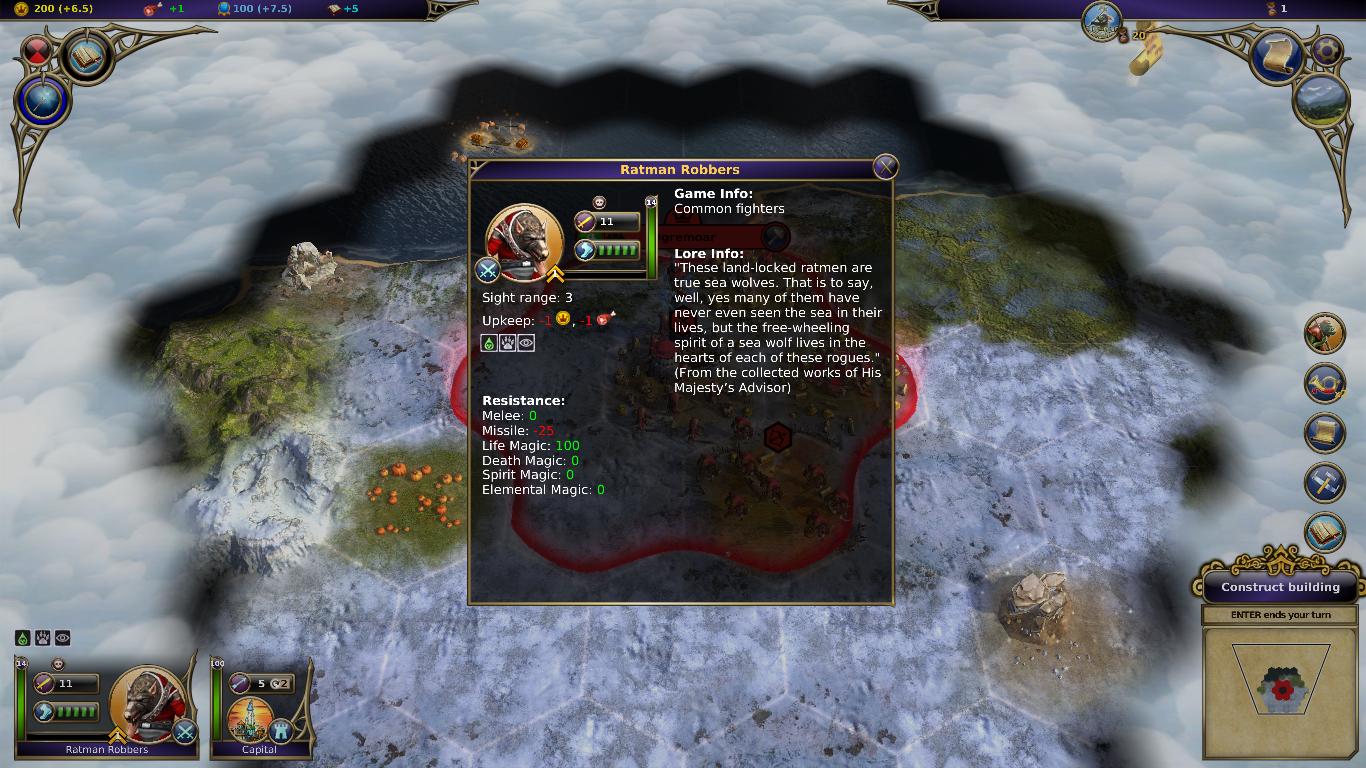
Ratmen.  More games need ratmen.

To start with, and pretty obviously with a name like Warlock: Master of the Arcane, this is a game with a fantasy setting.  You can play as one of three different races (humans, monsters or undead) - each with different buildings and different units.  One of the best bits about Warlock is the sheer number of potential troop types available to you.  From goblin archers to rogues, imps, ghost wolves, zombies, earth elementals, rats, strong rats and ratmen - the roster reads like a who’s who of every fantasy game of the past thirty years.  What’s more, as your minions fight they gain experience and you can pick perks to enhance their lethality (lethalness?).  There is something very exciting about creating and commanding your own fantasy army and letting it loose to lay waste to the surrounding countryside - and this provides one of the main reasons to play Warlock.  

This is certainly helped by the fact that the world that you live in (and lay waste to) is full to the brim with monsters.  You can’t move three hexes without bumping into the mangy little beggars.  This makes your surroundings much more of a living, breathing environment than would otherwise be the case.  The monsters are a source of experience for your troops, and their lairs provide loot for your budding kingdom - but they also make you feel like you are exploring, rather than just trying to work towards your victory goal. There is a real sense with this game that there are secrets and wonders hidden away behind the fog of war that surrounds you.  A good example of this are the sea monsters.  A Leviathan, or a sea serpent, will quickly kill your caravel or equivalent in a way that is reminiscent of old maps with “here be dragons” fearfully scrawled across them.  The world is full of dangers for your troops,especially at the beginning of the game, and this can lend some genuine tension to moving units before you have gained access to the more powerful armies.


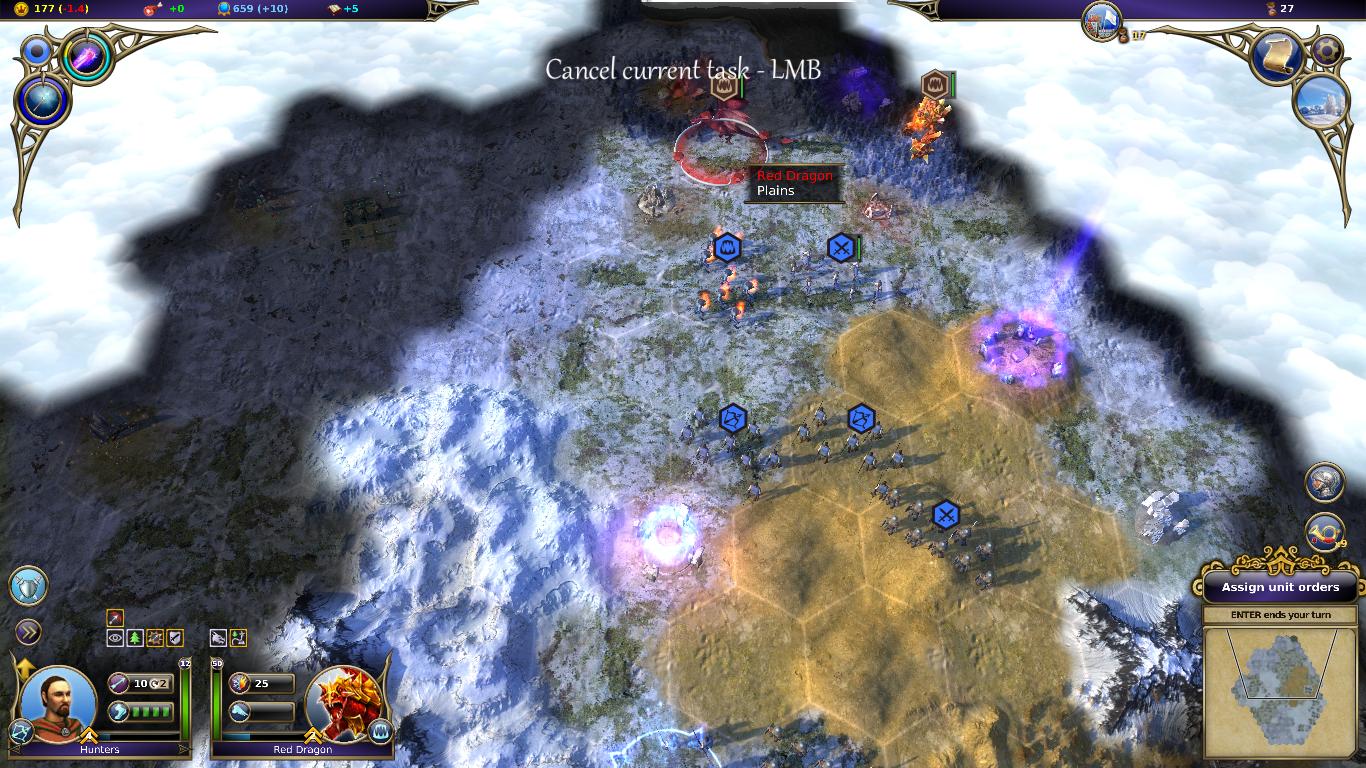
Welcome to the new world, same as the old world

This sense of exploration is enhanced by another addition to Warlock - alternate planes.  There are portals on the world map which lead to locations in dimensions other than your own.  Your troops can go through these and explore these worlds, which often contain great perils and great rewards.  It’s a good idea, but unfortunately the execution leaves a lot to be desired.  The new dimensions don’t actually appear to be too different to your own.  They use the same tileset and the rewards are the standard gold or mana - there are just a lot of powerful monsters living there.  It would have been great if these worlds were truly different and your troops were transported to a hell, or a heaven - or something truly remarkable.  As it is, they provide a nice distraction and a challenge but it could have been so much more.

Another difference between Warlock and other strategy games is that, well, you are a warlock.  This may sound obvious but, as an archmage, you are able to research spells.  This takes the place of the more normal technology research that appears in (cough) other games and provides another strategic dimension to the goings on.  Spells can have many and varied effects - teleportation, summoning, buffs for your troops or the more direct fireball and its ilk which deal damage straight to your enemies.  These can often turn the tide of a battle, but beware because your enemies also possess them and will use them often and to great effect.

So this all sounds great - it’s a grand strategy game with a fantasy setting, alternate dimensions, loads of cool troops to command and some decent spells with which to destroy large portions of the countryside.  What’s not to love?  Well, unfortunately it’s not all rosy and  there are some problems that we probably need to talk about.

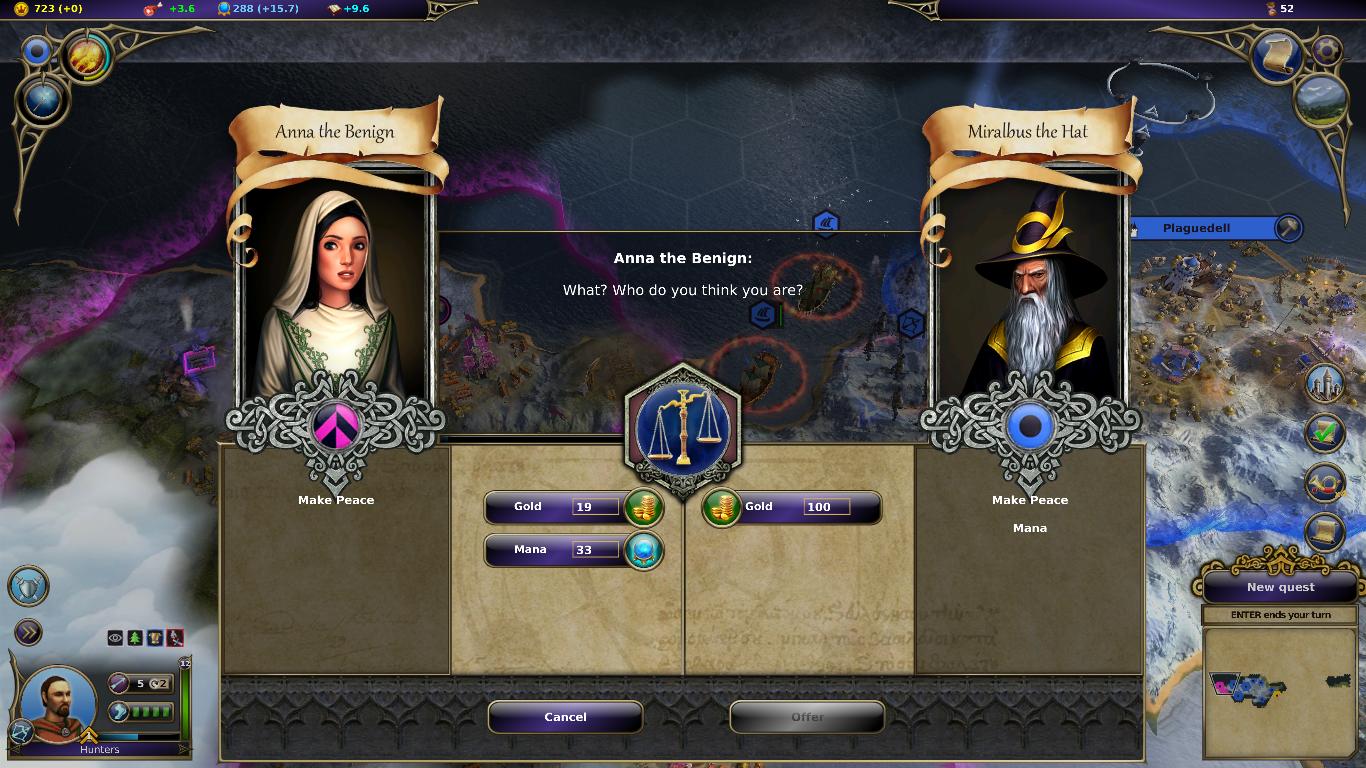
It might look like butter wouldn’t melt but she’s evil, EVIL I TELL YOU!

Let’s start with diplomacy.  It is present but it is very limited.  You can ally or trade with other mages, you can declare war or you can demand tribute and that’s about it.  If another mage contacts you to ask for gold or mana then the only options available are  “yes, take all my stuff” or “no, have at you sir, this is war”.  There are no subtleties, no negotiations, nothing except “yes” or “no”.  It’s all very basic, and this is a shame because it turns the other leaders, who actually look quite interesting and varied, into mere pictures because they all act the same.  For example, in a recent game I bumped into “Anna the Benign”.  I reasoned that she’d probably be a pacifist, especially as my leader was also a human good type.  Before long, however, she was gleefully breaking stereotypes, demanding gold and threatening war.  The leaders don’t seem to have any personalities of their own, they all give the same responses to the same situations as their peers.

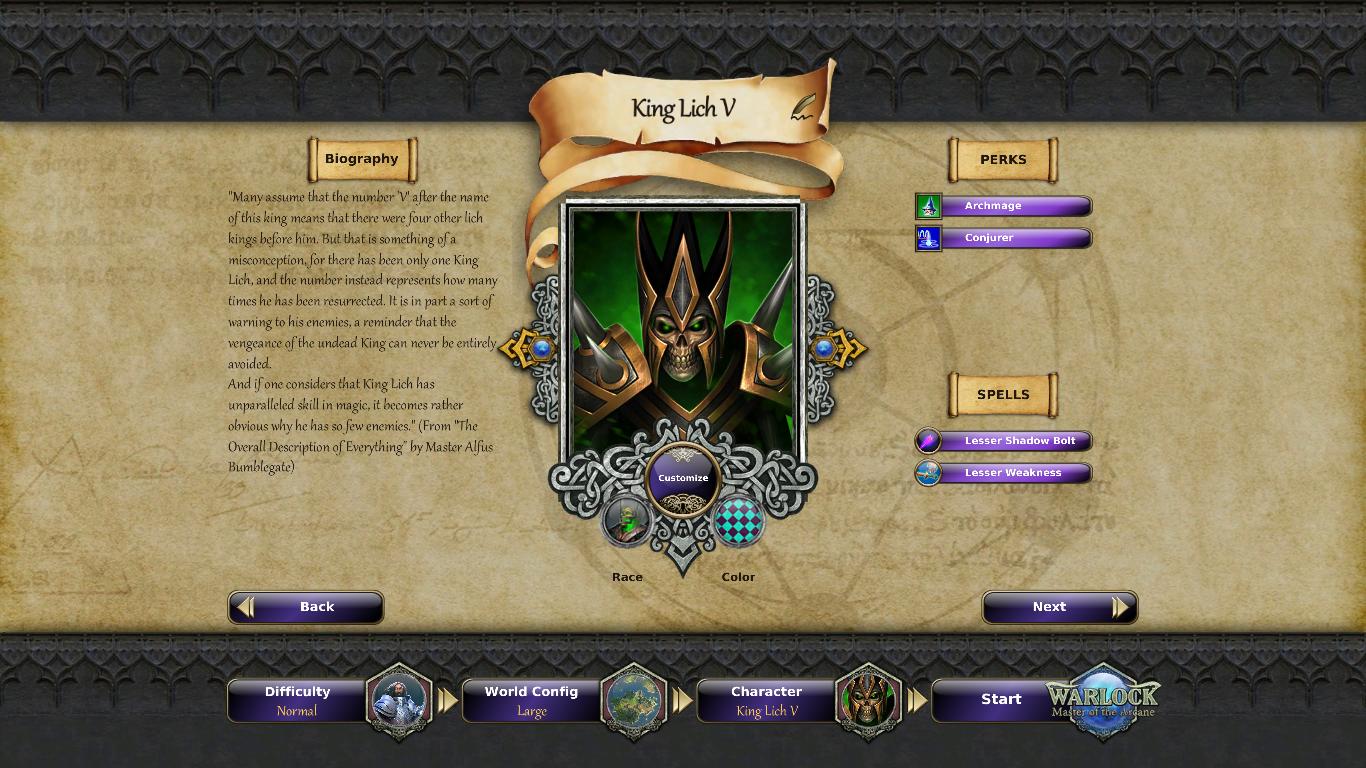
Another probem area is religion.  This is present in Warlock but it is, again, undefined and very basic.  There are eight gods in Ardania and your relationship with them varies according to whether you complete their quests or not.  If you annoy a god sufficiently he will send an avatar to smite you, and defeating this is one of the ways to win the game.  On the other hand, cultivate a decent working relationship with a god and you can access extra units and different spells.  This all sounds good, but there are no backgrounds to any of them.  They’re just names.  You can work out a bit about them from the spells they control but it would have been so much better to know who it is exactly that you’re worshipping.  If you’re playing the Lich King you don’t want to be following some namby pamby nature god, do you?


Hang on... you’re an ELF?!?

And both of these issues reflect a more general problem with Warlock.  It lacks polish.  For example when you have finished giving orders to a unit you have to press the “Assign Orders” button to move on to the next, the game doesn’t do that automatically.  You can feel sometimes that you are fighting the interface and it makes moving a large number of troops a real chore.  Similarly the spell research screen doesn’t seem to follow any system.  You would expect that all fire spells, or all healing spells, or all summon spells or however you want to classify them would follow on from each other but they don’t.  The selection appears to be completely random.  It means that you can’t follow a particular path for your mage, because you don’t know which path to follow or even if there is a path at all.

So where does this leave us?  It would be easy to dismiss Warlock as just a Civ V mod.  It isn’t, and I think that this is lazy and unfair.  It’s true that it does share a lot of similarities with its “inspiration” but it also introduces and uses a number of other really interesting ideas.  However, the main problem is that a lot of these ideas aren’t implemented fully, or with enough polish.  As it stands the game should be commended for creating a very good strategy / exploration mix, and allowing the player to assemble a motley fantasy army with which to wreak havoc - but it could have been so much more. It falls just short of greatness, and that is a real shame.


Friday, 20 April 2012

Indie Review - MolyJam

Recently I have been doing a bit of writing for "The Digital Fix".  Part of that is a (roughly) fortnightly column rounding up some of the indie stuff out there that people may have missed.  The reviews of Yeti Hunter and Realm of the Mad God (which I underestimated and am still playing) are from there.  However, I have decided that I might as well just re-produce the whole thing here - as it is increasingly moving away from having a "main" review and more into lots of equal parts....
Indie Review - MolyJam


MolyJam!

Usually when somebody starts a parody account on Twitter they confine themselves to, well, parodying their subject.  However, sometimes what starts as an affectionate send up can end up becoming something quite different.  

@PeterMolydeux is a parody account.  It gently mocks the famous game designer Peter Molyneux - who made such classics as Populous, Theme Park, Black and White and the Fable series.  Molydeux (as Molyneux) tweets different game ideas – “You are a bin, by day people are throwing litter in you but by night you use that litter to highlight issues in the city through modern art” or “You are a pigeon who must go around the city trying to persuade business men not to jump off buildings by retrieving items from their home” -  that urge game developers to “think outside the box”. They stress emotion over action and innovation over repetition.  His assertion is that games have become too standardised, too cold and too safe.  He says that creativity is being stifled and that gamers are suffering because of it.  The thing is that, after a while, people stopped looking at this as just somebody imitating Molyneux and started to think “some of these ideas are interesting, what if we actually made some games using them?”  and eventually MolyJam happened - announced by the man himself in this video


MolyJam was a massive gaming meet up.  Game designers, developers and people from all walks of life came together in many different places around the world, for 2 days, and built games based on Molydeux’s tweets.  The result was (at last count) 302 very different offerings; all for free, and all available here.  

As you can imagine, things can vary wildly from game to game, even when the inspirational tweet is the same.  Some are unfinished and most will occupy you for less than ten minutes - but all are interesting.  My personal favourites are Amour Parkour (two lovers run across an urban landscape until something special happens), Huggy Bear! (which details the emotional effect on a bear of being too strong to hug people) and The Shadowland Prophesy (an amazing cel-shaded RPG, with lasers!).  Taken together the collection provides a cornucopia of innovation and creativity.  Be prepared for things not working quite as you expect, but  if you approach it with an open mind then it will reward you with something that is truly different.

I would like to think that MolyJam will live up to Molydeux’s claims and change at least some of the ideas in the industry.  But even if it doesn’t, it has shown that some genuinely beautiful games can come out of thinking a bit differently, trying new things and generally taking the mick out of a gaming legend.  Go and have a look!

The Republia Times


Have you ever wanted to work for an Orwellian propaganda agency?  Have you ever fancied having your family held hostage by a dictatorship, with their safety dependent on your work performance?  Probably not, but if you do fancy it then The Republia Times gives you such an opportunity.  It puts you in the position of Editor of the aforementioned publication, just after a change of regime.  Your job is to quell unrest, increase the readership and ensure that your kidnapped family remain healthy.  You pick which stories to cover and how to place them on the page in order to produce the desired effects on the brainwashed populace - with targets and (literal) deadlines regularly set.  Tension quickly builds and before long you’ll be manipulating public opinion with the best of them.  The game is played in your browser, costs nothing and is well worth a look.

Get it here
Cost:  Free!

One to Watch - Xenonauts


X-Com (or UFO: Enemy Unknown as it is known in Britain) was released in 1994.  Created by legendary games designer Julian Gollop it is regularly voted as one of the greatest games ever made.  It mixes real time and turn based combat, strategic and tactical gameplay, character progression, research, manufacturing and a whole lot more to create something quite unique.  There have been many attempts to duplicate the game’s success over the past 20 years, but none have really managed it.  The good news, however, is that that may be about to change as there are a couple of very promising projects on the way.  Firaxis have their well-publicised, big budget “re-imagining” in the pipeline but Goldhawk Interactive have also been beavering away on Xenonauts for the past couple of years.  Xenonauts promises to be the most faithful of the two to the spirit of the original, it still uses time units for example, and is clearly being made by people who are massive X-Com fans.  Using such a revered game as the basis for your project is always going to be risky, but Goldhawk are making all the right noises and, from what we’ve seen of the game so far, they appear to be doing a great job.  As is usual with these things you can support the game’s development by pre-ordering on their website.  This gives you access to the current development build, and the finished game at a reduced price.  More importantly it helps Goldhawk realise their vision for what is looking to be a very promising modern take on an all-time classic.  Could this finally be the game to do the original justice?  Let’s hope so.

Pre-order here
Cost:  £14.99 / £19.99